It’s hard to deny the monumental impact that the “Age of the Customer” has had on e-commerce.
Today’s customers are smart, connected, web savvy, and fiercely disloyal. They enjoy a growing array of product and brand choices.
This may sound like a recipe for disaster to anyone in the e-commerce sector. But, for smart web stores, this ultra-competitive landscape actually presents an excellent opportunity to expand customer service and stand out from the crowd.
To be successful in today’s online marketplace, web stores need to focus on delivering the full customer experience. This is quickly becoming the differentiator in customer decisions, and it should be something that web stores are jumping all over.
Surprisingly, though, this opportunity is still being missed by the majority of web stores today. As important as customer satisfaction is, companies just aren’t delivering. Only 1 percent of customers feel their expectations are always met.
Whether they realize it or not, web stores now are competing primarily on customer service. Apart from offering a great product for a great price, customer service clearly is the new battleground.
The way to win this battle is to provide customers with an experience that’s as seamless and effortless as possible, and embrace real-time conversations as the weapon of choice. Customers love it, and it contributes to a more profitable web store.
Want to win the marketing battle? Take charge with real-time, personal, and effective conversations through live chat. Here is how to get started:
Why is Customer Service the New Battleground for E-commerce?
It’s no secret that today’s online shopper has more choices than ever. New web shops are opening every day, and great (new) products continually flood the marketplace.
To put it simply, it’s a jungle out there, and customers are lost among all the names, choices, options, and brands. What’s worse? Customer loyalty is at an all-time low. Brands just don’t have the staying power they once had (or were thought to have).
Add to this mixture: big companies are starting to upgrade their customer service strategies and social consumers are demanding instant (and 24/7) gratification. Competition is tough, and customer expectations have never been higher.
The implications of poor customer service run deeper than was first thought. It is not a surface problem or an itch one can easily scratch. A look below the surface shows that poor customer service has an incredible impact on revenue. A recent Forrester study proved that 45 percent of U.S. shoppers will abandon an online transaction if their questions or concerns are not addressed quickly.
This statistic alone should be enough to motivate web stores to improve their customer service strategies, but it gets worse: 91 percent of customers leave after a bad customer service experience and will not willingly do business with that company again. Gulp!
In addition to costing a company lost customers and abandoned shopping carts, poor customer service is a slow drain on a web store’s resources and efforts. As a result of poor service, interaction times are longer, costs are higher, and companies lose out on valuable opportunities.
Companies that are competing in today’s marketplace need a game plan and a real differentiator.
Today, more than ever, customer service matters.
Why Conversation?
How are conversations key to winning the customer service battle?
It’s simple. Customers want instantaneous service and live chat.
An ATG Global Consumer Trend study found that 90 percent of customers consider live chat helpful, and a survey by Emarketer.com found that 63 percent were more likely to return to a website that offers live chat!
More customer needs are fulfilled through live chat than any other medium. It offers the lowest response time and has a higher customer satisfaction rating than any other customer service channel.
Live chat also helps to generate a more profitable web store. Since conversations help you resolve customer questions and inquiries quickly and efficiently, it decreases shopping cart abandonment and helps expedite the checkout process. Chatters (those engaged in live chat) spend an average of 55 percent more than non-chatters do.
As a web store, it’s imperative to use live chat, not only as a way to increase revenue, but also to help you better deliver on your brand promise and offer customers deeper insight into your product, thus boosting customer satisfaction.
Focus Your Efforts on Maximum Satisfaction, Loyalty, and ROI
We’ve all heard the rumors. It’s long been advocated that companies should amaze, wow, and delight their customers each and every time they have contact. Advocates of this strategy insist that dazzling customers with over-the-top experiences will create loyal and dedicated customers.
Unfortunately, delighting customers with over-the-top experiences, isn’t an effective way to build customer loyalty.
A recent Harvard Business Review study reports that customer service interactions are four times more likely to prevent a customer from leaving than they are to create customer loyalty. So, the best use of customer service isn’t to “wow” customers into a permanent state of loyalty but to prevent them from jumping ship.
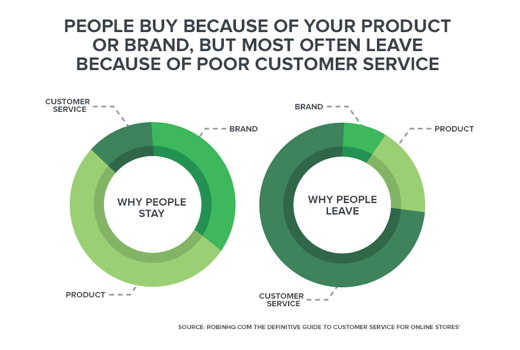
When a customer contacts you with a question or issue, what they really want is for their problem to be solved, as simply and quickly as possible. That’s it. Companies that can do this and prevent dissatisfied customers from leaving are already ahead of the game.
But what about dazzling your customers with over-the-top experiences? The reality is that most independent online stores work in small teams and have a lot to do with limited resources. Asking them to go above and beyond with their customer service each and every time means that gaping holes will be left in other places.
Fortunately, there is a better way. E-commerce customers don’t expect to be delighted, and most do not particularly care about that. In fact, customer satisfaction actually has been shown to plateau once expectations are met.
In the previously mentioned Harvard Business Review study, researchers suggest that focusing your customer service efforts on “wowing” each customer, every time, can be a counter-productive strategy if your business is still failing to deliver on plain vanilla promises. It’s far better for companies to focus on meeting expectations before pouring resources into attempting to dazzle customers.
There seems to be a major disconnect between the customer service that companies think they are providing and the customer service that customers actually are receiving. Eighty percent of companies think they are meeting customer expectations, but only 8 percent of their customers agree that they are. Such companies are negligent, which causes them a loss of revenue and reduced customer loyalty.
So, if you want to take care of your customer needs and get the best results for minimal costs, here’s how you can focus your customer service efforts:
- Know Your Customer: Your intent should be to build knowledge around customer needs so you can deliver on expectations. Remember, customers primarily want their expectations met. The only way you can deliver is to know what the expectations are in the first place. Real-time conversations are an excellent way to gain valuable insight into customer needs.
- Reduce Customer Effort: Your development should be focused on reducing customer effort throughout the entire shopping experience. This has been shown to actually increase customer loyalty and make customers want to come back. By offering live chat, you can ensure that your customer shopping experience is as effortless as possible.
- Solve Problems Instantly: Your customer support should work toward instantly solving customer problems. In understanding their needs and anticipating their questions, you can actually solve a problem before it arises. Imagine that?
How to Develop a Customer Service Manifesto to Set Expectations
For any e-commerce company, managing customer expectations is the first step toward ensuring that customer expectations are met. One of the best ways to do this practically is to develop a customer service manifesto that clearly outlines who you are and what you offer. This manifesto should go in your About Us page, and it should show customers at a glance exactly what they can expect from your company.
Your manifesto should contain three important aspects of your business:
- The core of your brand – what you stand for
- Your value proposition – why customers should buy from you rather than someone else
- Your service goal – what customers can expect when they do business with you
Having a clearly stated and well-written customer service manifesto on your website will help customers form realistic expectations about your company before they place an order, and it will ensure that your company delivers on those expectations.
How to Set Your Customer Service Strategy
You’ve no doubt built your web store from the ground up. You’ve worked hard to expand your knowledge and experience and solved countless problems along the way.
Now, it’s time to scale! Creating a customer service strategy can help you to do just that.
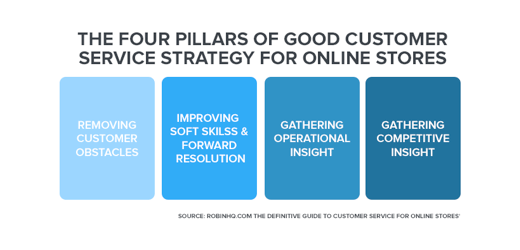
Here are four solid pillars that should be central to your customer service strategy. Each one of these principles is designed to get results. Incorporating these principles into your strategy will form a solid basis for your plan that will help you grow your customer base, build customer loyalty, and prevent customers from leaving.
1. Remove Customer Obstacles
If you want to improve conversion rates and build loyalty, your customer service strategy should center on making life easier for customers. Ninety-six percent of customers who have to put a lot of effort into their purchase (many sign-up fields, poor checkout flow, etc.) end up disloyal, even if they love your products. Conversation can help remove obstacles and reduce the amount of effort a customer has to put into their shopping experience.
2. Improve Soft Skills
An estimated 24 percent of repeat customer calls stem from emotional disconnects between customers and representatives. Improving soft conversation skills and forward resolution will help you build stronger emotional connections with customers. This can help stop churn, build loyalty, and reduce costs.
3. Collect Operational Insight
Use your customer service conversations to gather operational insight to help improve your internal processes. You can relay this data back to your user interface and throughout the entire company. This will optimize your customer service approach, lower the number of support requests, and prevent similar problems from reoccurring in the future, helping to improve profitability.
4. Gather Competitive Information
Make sure your customer service strategy includes gathering competitive insights. This means using your customer support conversations to help identify more up-sell, cross-sell, and assortment opportunities, keeping you ahead of the competition.
Start by Strengthening Your Customer Service Line of Defense
While your goal through customer service should be to address and resolve customer concerns quickly, it’s far better if there are no issues in the first place.
Prevent problems and customer service issues by making sure your website contains all the information your customers need to make informed purchases. This will improve conversions, keep customers happy, and save money.
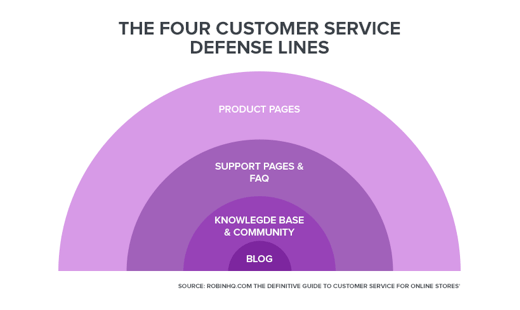
Product pages, support pages, your FAQ’s, and blog are the top locations that customers visit to get information on your products and services. If you can provide customers with organized and digestible information from the beginning, this will minimize the barriers to clicking through and buying from you. The following defense lines are listed in hierarchical order of importance:
- Product Pages: Provide as much detail as possible on your product pages and be extensive in your product specifications. Show big pictures and videos of your products in context. A clear image of your products allows customers to know exactly what they are purchasing, helping to prevent customer disappointment.
- Support Pages: Be as crystal clear as possible about your service levels and terms and conditions on your FAQ and support pages. Communicate your delivery times, refund policies, and payment options.
- Knowledge Base: Your knowledge base can be a valuable tool for providing customers with information they need, but don’t abuse your knowledge base by using it as a catch-all for random information. This strategy is like sweeping dirt under the rug! It’s far better to put answers to questions in the right context. For example, instead of putting your delivery information on your FAQ page, make delivery options clearly visible on your product pages so customers can easily find them.
- Blog: Use your blog to showcase your products in context. People love videos and images, so use them to show your products in action. Again, this is an excellent opportunity to show customers exactly what they can expect, preventing unnecessary customer service queries.
How to Measure the Success of Your Customer Service Strategy
It’s important to measure the success of your customer service strategy. Here are some indicators that you should watch:
- Churn: Customer churn is a key indicator of customer disloyalty. Measuring customer churn shows you exactly how well your company is building customer loyalty.
- Total Volume by Channel: Look at the volume of help requests by channel to find out which channels are most popular with customers, and dedicate resources toward the ones that more customers are using.
- Response Time: Response time is an important indicator of customer satisfaction. A 2013 LivePerson Connecting with Customers report showed that 71 percent of customers expect online assistance within five minutes. If they don’t receive help in their expected time frame, 48 percent will abandon that website.
- First Contact Resolution Rates: This is an important part of making sure customer issues are addressed as efficiently as possible, and it’s vital for customer satisfaction. Eighty-four percent of customers want their problems resolved in one friendly service conversation.
- Forward Resolution Rate: Your forward resolution rate is a valuable indicator of how well your company uses information from customer service conversations to improve your internal processes. This looks at how well your company prevents the same problem from reoccurring.
- Customer Effort Score: Tracking customer effort will show you how loyal your customer base is. As we’ve discovered, customer effort has a direct impact on customer loyalty. The more effort a customer has to put into an experience, the less loyal they are likely to be.
- Rep Knowledge: Knowledgeable customer service reps are a key factor in customer satisfaction. Ask your customers how well the representative handled their issue.
- Cost to Resolution: The cost to resolution is the costs that are involved in handling the customer’s issues or problems. Tracking this allows you to see exactly how many resources you are directing toward solving customer issues.
- Net Promoter Score: The net promoter score asks the customer: “How likely is it that you would recommend our company/product/service to a friend or colleague?” This provides you with valuable insight into customer satisfaction.
When viewed together, this data will help paint a clear picture of how well your company is performing and help you track, improve, and optimize your customer service strategy.
Conclusion
In the end, it’s important to remember that customer needs are fairly straightforward. They simply want their expectations met, on time, and with no annoying delays or problems.
Continually optimizing your customer service strategy to ensure that it’s designed to make things easier for your customers is one of the best ways to increase customer satisfaction and build customer loyalty.
Companies that capitalize on this knowledge will put themselves a step ahead of the competition and will be well on their way toward finding success in today’s competitive marketplace.
About the Author: Michiel Gaasterland is the marketing director behind ROBIN, the all-in-one customer service solution for web stores. Gaasterland has been in the marketing industry for nearly 20 years, founded his own startup, and actively helped other fast-growth companies achieve global success. Gaining more recognition as the customer service man, he was pivotal in publishing The Definitive Guide to Customer Service for Online Stores.


