Showing posts with label Customer Experience. Show all posts

Friday, July 18, 2014

Measuring the customer experience takes more than one metric: Gartner

WASHINGTON, D.C. -- Managing the customer experience seemed to be a major priority for many attendees here at the Gartner CRM Summit, where it was the central theme of the opening keynote.
While much of the focus on CRM has shifted to better managing the customer experience, it comes with a significant challenge, according to Ed Thompson, vice president and distinguished analyst with the Stamford, Conn.-based analyst firm.
"How do you measure it? This is the biggest question we get," Thompson said.
The answer, unfortunately, is not so simple. And it's not for lack of interest.
According to recent research from Gartner, 80% of executives think customer satisfaction is more important than it was three years ago, and 95% of business leaders see it as the next competitive battleground.
"Everything else is easy to copy," Thompson said, referring to price, product and delivery. "This is a topic for many, many organizations at the board level."
Customer experience may be a critical consideration in the offices of upper management, but throughout the rest of an organization it is often less of an issue, he added, because "they don't get paid for it."

Pro+

Features

Enjoy the benefits of Pro+ membership, learn more and join.
Organizations are measuring the customer experience -- they're just doing it in multiple ways with little collaboration. For example, customer satisfaction is typically measured in sales, service or market research. Loyalty is measured by churn/retention, referrals or loyalty management. The brand is measured via marketing communications, product and service design and user interface design, while quality is measured by process improvement and product engineering.
"I have repeatedly shown up in meetings, and these people who have never met each other are suddenly introducing themselves," Thompson said. "Don't think because you're in one department, other parts of the organization don't care."
More on improving customer experience and Gartner's CRM summit
Find out the role of the chief customer officerin improving customer experience  

Check out the top-five headlines in customer experience management  

Read coverage ofGartner's CRM Summit in 2007
There is no one measurement of the customer experience, he said. Many organizations focus on loyalty, but that paints an incomplete picture.
"In many cases, customers screw you," Thompson said.
Many companies measure only rational loyalty, he said, while emotional loyalty -- the kind that convinces customers to get tattoos of your brand -- is the kind of loyalty that really needs to be measured. Emotional loyalty correlates directly to profit. The problem is, emotions change quickly and demand different sorts of questions in surveys, which need to be conducted very frequently.
The Net Promoter Score (NPS) is a popular metric that accomplishes some of this, asking simply how likely a customer is to recommend your company or product to someone else. The NPS, Thompson said, is good for causal analytics but not for B2B companies.
"It has some capture of emotional loyalty and some benchmark information," he said, "but most important it is simple and appeals to the board of your company."
Most companies run on an average of seven metrics and use the NPS as the one metric they give to the board.
"The battle is on in the post-NPS world," Thompson said. "Most organizations have their own derivative of the net promoter score."
Thompson offered seven recommendations from Gartner for improving the customer experience.
Listen, think, do: Many organizations survey more than they ever did before. "Everyone is surveying customers to death, sticking it in an inaccessible database and not sharing it with anyone and annoying the heck out of customers," Thompson said. Forward-thinking organizations make sure they act on the feedback. Only 5% of companies tell customers what they have done as a result of that feedback, according to Gartner research.
Design process from the outside in: Find the two or three processes that customers care most about and design them from the point of view of the customer.
Use multiple channels: "This is where IT tends to lead the charge," Thompson said. This is the slowest, hardest work of any of these projects, he said, and the problem is often politics: Who owns the customer and the data associated with it becomes a hurdle.
Be open and exclusive: The combination is possible, according to Thompson. Organizations need to be transparent to their customers while showing them their respect and organizing communities that encourage participation. Missha, a Korean cosmetics manufacturer that has gained 40% market share in its home country in just a few years, has done this by co-creating cosmetics with teenage girls online, Thompson said.
Personalize products, services and offers: "As you get to one-to-one [relationships], things tend to get extraordinarily complex," he said. The Nike Plus, which transmits information on a runner's time and distance to his iPod, is a product that is simple for the user (just plug it into your iPod) but creates an enormous amount of personalized information.
Alter attitudes: Most executives cite employee attitudes around the customer experience as their biggest challenge, but this is an area where HR can help, Thompson said. Since 1998, Southwest Airlines, for example, has made a point to hire people who smile, not just the frontline employees -- but the back-office employees who can affect front-office attitudes as well.
Plan and design the customer experience from scratch: Disney designed the parking lots of its parks with a focus on the customers and getting them out as fast as possible, thereby ensuring the memories that lasted were of the rides and the day, rather than looking for their cars with tired children, Thompson noted. Disney assigns cars to the lot by the time they arrived and provides key-cutting and towing services.
"It's OK to have different measurements; just get everyone who cares about it together to look at it," he said.
At the least, organizations should have an NPS derivative specific to their industry, and if they're at the top, Thompson said, they should look to other industries as well.
The keynote provided validation for Bill O'Connor of the New York Department of Criminal Justice and an attendee at the event.
"I'm getting a sense we're at the forefront," O'Connor said. "We're looking now where we can move for improvement."

Tuesday, December 27, 2011

2012 Customer Experience Predictions: Positives and Pitfalls


A new calendar year gives us a new threshold to cross, providing an opportunity to look back at what we've learned, and to look forward, leaving often bleak times in the past. As I look forward to 2012, I see a global business landscape filled with hope. But I won't run carefree into the New Year, and neither should you.
Building on the experience I've acquired, the news reports I've followed and my understanding of the global economy through the client work Beyond Philosophy has done, 2012 also will be pockmarked with pitfalls that can devastate business plans and damage entire industries. What are the highlights? The dangers?
Beyond Philosophy is approaching 2012 with the following predictions in mind:
  1. Business leaders will finally accept that the world financial crisis is here to stay – at least for the next few years
    No matter where you are in the world, you have seen bleak news reports outlining the financial malaise we're suffering through. It's not going to get better anytime soon. The "good old days" are behind us; the next few years will be rocky and it's our job to adapt and get through it as smoothly as possible.
  2. Innovation is in the air
    Around the world, governments and corporations alike have caught the "austerity bug," meaning leaders have a strong reluctance to invest in capital-intensive projects while simultaneously cutting costs. The austerity bug, for some businesses, has meant resignation, complacency and defeat – but I choose to look at management's increased drive for cost-savings as a positive. Austerity, as it turns out, is a friend of innovation.
    More than ever before, when it comes to spending management has to take a hard look at resource allocation. Businesses are caught between the mass commoditization of their products and services and the need for austerity. Commoditization created a need for increased competition, resulting in the development and growth of the customer experience management industry.
    In a period of economic recession, it might seem to make sense for companies to cut back until the economy recovers, but this prolonged recession is anything but ordinary. A client recently explained to me, "we've been cutting back, but it gets to a point where the competition is so fierce that we have to invest in improving our customer experience so we don't lose all our customers." Consequently, being stuck "between a rock and a hard place" increased competition and austerity has turned leaders toward the customer experience as a cost-effective way to drive business value, retain existing customers, acquire new customers and improve the organization's competitive edge.
    In Beyond Philosophy's 2011 Global Customer Experience Management Survey we found that in spite of the recession, CE growth is increasing in high-maturity markets in the wake of commoditization. CE growth in high-maturity markets (especially in certain niche sectors like manufacturing), combined with the drive for CE as a competitive response in mid-mature markets, provides a compelling case for optimism.
  3. Organizations will loosen the purse strings and start spending cash reserves 
    Once the Eurozone crisis settles down – probably in the second half of the year – the time will be ripe to invest cash reserves organizations have built out of economic concern into customer experience initiatives. Given what we know through our research and through client interactions across the globe, CE is poised for growth.
    Analyst Thomas Hirst, writing for FundWeb, critically observes that "while holding cash during uncertain times might appear a prudent policy… [it] acts as a drag on equity returns." Companies like Apple, Inc., that are sitting on billions of dollars of cash, are only contributing to the economic malaise. We will see more forward-thinking organizations invest some of their cash into CE initiatives. By deploying cash to capture customer experience as a new avenue for growth, these companies will reap significant long-term benefits.
  4. Investment in emerging markets will increase substantially
    I've been taken aback by the truly global scope of the customer experience. The world, it seems, has caught on to the power and results a great customer can deliver. In fact, in 2011 Beyond Philosophy engaged with clients and responded to requests from such far-flung regions as South Africa, Uganda, Nigeria, Dubai, Kuwait and Egypt. In mid-mature countries, there is a strong push within retail to for the emotionally driven "luxury" experience of Western brands among the burgeoning upper-middle classes. The BRICK countries (Brazil, Russia, India, China and South Korea) are also top players in this scene. On the bright side, these regions have not been as badly affected by the global economic crisis as regions in the west.
  5. Understanding and acceptance of customer experience as a business strategy will improve
    Growing numbers of leaders are beginning to understand the opportunities they're losing by just focusing on the rational experience. They are validating the emotional aspects of CE as a vital component of their organizations' identities. Embracing the cultural change required to deliver a world-class customer experience means converting the customers and employees into emotional stakeholders in your organization.
    Commoditization in saturated markets has been responsible for the increasing demand for irreplaceable, one-of-a-kind interactions between producers and consumers. We try to ferret out the best examples, including Volkswagen's Transparent Factory, Tesco South Korea's QR code-enabled subway station grocery store and Spain's perfume-selling restaurant, Cellar de Can Roca, in our blog.
    But the news isn't all good. As we also identified in our recent study, there are threats to the customer experience industry that must be addressed.
  6. The definition of customer experience will continue to be misunderstood
    There is a profound lack of conceptual clarity among organizational leaders regarding what does and does not comprise customer experience management. For organizations that are taking the lead by investing their reserves on customer experience initiatives, misunderstanding of the term represents a grave threat to both the success and the future prospects for the practice.
    Customer experience initiatives are not instant fixes, but they can provide significant, long-lasting results when executed properly. Through customer experience management, one of our clients improved its Net Promoter Score by 25 points in 18 months. The danger is when organizations think they are focusing on improving their customer experience when all they're really doing is "putting lipstick on a pig." In other words, they're continuing to do the same things, rebranding those activities as customer experience, and blaming the concept of customer experience when things don't work.
    The consequence is that a poorly designed CE program will destroy any future value for a promising and properly-implemented initiative. Compounding the issue is a loss of staff confidence in the effectiveness of CE as a value-driver, building resistance to any future CE program.
    I recently wrote an article entitled "Rebranding CRM as customer experience management: The road to ruin?" which offers an overview of how misappropriation of CRM as CEM by software vendors contributes to this misguided practice.
  7. Net Promoters Scores will continue to be the primary judge of customer experience initiative effectiveness
    Let me first say that I like Net Promoter Scores (NPS). I think they provide good feedback that organizations can use to understand their current positions and determine where they can improve. But relying solely on NPS to judge the effectiveness of a customer experience initiative is a danger to which too many organizations succumb. NPS is a good foundation, but organizations must overlay other measurements in order to build a complete CE picture. While it's been a challenge in the past, more organizations will begin to appreciate this fact.
  8. Opportunities for growth will exist in 2012
    Regardless of your outlook, be it optimistic or pessimistic, opportunities for business expansion through CE as an avenue for growth will exist in 2012. One implication of the financial crisis is the importance of customer retention versus customer acquisition. In an a spending environment marked by low interest rates and high inflation, a focus on building great customer experiences with your existing client base is a smart move, particularly since the cost of retaining customers is far less than the cost of acquiring new ones. In a spend-thrift driven recession, retention is an ideal strategy. In general, 80% of your profits come from 20% of your existing customers.
  9. Mobile devices will grow in market share and CE importance
    In addition to prioritizing customer retention, the digital world is the next frontier for CE in 2012. Mobile devices and tablets drive one third of our web traffic. In 2010, consumers spent more than one billion dollars ($1028 million USD) on Cyber Monday. What's even more shocking? In 2011, consumers spent 22% more, or approximately $1.251 billion online.
  10. Social media will continue to drive online CE
    Social media bolsters the digital customer experience as companies receive direct feedback from customers in real time. The prevalence of mobile and tablet devices, online shopping and social media sow the seeds in a fertile ground for CE growth in mobile technology in 2012.
In economic times like these, I'm reminded of a scene from an old black-and-white movie I saw many years ago that illustrates the reason we need to stay committed to CE, even in the post-recession world. In a high-speed car race, the lead driver had a major collision. When they interviewed the winner at the end of the race, he was asked about whether slowed down in the wake of the accident. He responded, "No, I actually increased my speed because I knew all the other drivers would slow down and this was my opportunity to win."
The financial crisis is our race. The key question is, "which you will drive?" Will you slow down or speed up? Necessity is the mother of invention, and 2012 will be the year in which the customer experience will continue to grow in importance around the globe, despite the problems the world faces.

Colin Shaw

Colin Shaw is founder & CEO of Beyond Philosophy, one of worlds first organizations devoted to customer experience. Colin is an international author of four best-selling books. Beyond Philosophy has a proven track record. They provide consulting, specialised research & training from Atlanta, Georgia and London, England. Follow Colin Shaw on Twitter ColinShaw_CX

Friday, September 23, 2011

Bottling Customer Experience

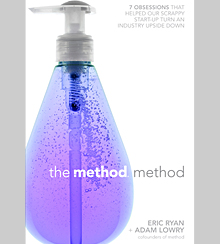
Theodore Kinni, coauthor of Be Our Guest: Perfecting the Art of Customer Service, introduces a lesson in creating product-based customer experiences from The Method Method: 7 Obsessions That Helped Our Scrappy Start-Up Turn an Industry Upside Down, by Eric Ryan and Adam Lowry, with Lucas Conley.
The best customer experiences tend to come from companies with major service components, like Disney and Ritz-Carlton. Their business models place them face-to-face with customers, and their fortunes rise and fall on their ability to provide compelling experiences, as Starbucks discovered a couple of years ago. But most product companies, especially those that don’t sell directly to end-users, don’t think quite as rigorously about customer experience.
Enter Method Products. Method is one of those delightfully quirky entrepreneurial stories. In the late 1990s, two 24-year-old guys — an ad man and a climate researcher — take off on a ski weekend and decide that the home cleaning products industry is ripe for a shakeup. Never mind that it’s a mature, relatively stagnant market dominated by powerful brand names like Procter & Gamble and the Clorox Company. Never mind that everybody else is starting e-businesses. Never mind that they are two 24-year-old guys on a ski weekend talking about cleaning products. By 2010, their privately held company is generating annual revenues somewhere north of US$200 million; it counts major retailers, including Target, Whole Foods, and Auchan, among its accounts; and the big dogs are tracking it.
How did Method do it? One way, as detailed in the excerpt below from the new book by Method cofounders Eric Ryan and Adam Lowry, was by zeroing in on the abysmal experience associated with so many home cleansers, such as the eye-tearing, nose-burning, skin-irritating sensations that can transform a minor decision about who is going to clean the bathroom into a domestic negotiation of epic proportions.
— Theodore Kinni


Excerpted from “Obsession 6” of The Method Method: 7 Obsessions That Helped Our Scrappy Start-Up Turn an Industry Upside Down


Most companies underestimate the power of emotional differentiation, focusing instead on functional differentiation. Rational, fact-based, “hard” attributes always play well in boardrooms and focus groups, but they don’t reflect the real way consumers think and act. Consumer loyalty is the result of a brand’s ability to stand out on both functional and emotional attributes. Sure, most consumers consider functional attributes more important than emotional ones, but what if all your competitors have the same functional attributes? You’ve got to stand out somehow — and studies by Forrester have shown that brands that distinguish themselves on emotional attributes can capture 60 percent greater loyalty.
So to achieve high levels of loyalty, today’s new brands have to focus their resources on a select few functional attributes on which they can double down — often requiring them to divert resources from less important ones. An example in nearby Berkeley, California, is Berkeley Bowl [Marketplace]. It’s a foodie’s paradise, with a ridiculous selection of fresh produce and exotic goods. Problem is, it’s a customer-service nightmare, with long checkout lines, overwhelmed stockers, and crowded aisles. The store purposely overinvests on delivering great selection while willingly sacrificing on service. Walking through the store, you can’t help but wonder, “Don’t these guys value customer service? Is the produce that good?” For a select group of devoted Berkeley residents, it is — and Berkeley Bowl has built its business on that emotional response. Most of us, however, would rather go to a place that satisfies our desire for strong quality and great service. This is the most effective way to deliver emotionally distinct experiences — by linking them to your brand’s “shared values” with a specific consumer. This reinforces the importance of mission, purpose, and POV [point of view]. And emotional connections via shared values can be built faster than you might think! That’s why, at Method, we match the sensory experience to our advocates’ shared value for “the love of clean.”
Let’s start with the toilet. Toilet bowl cleaner is a great example of the importance of ensuring that every experience has a strong functional side. This was one of the first products we wanted to do back in 2001, but Method didn’t enter the category until 2008. The tale of how Lil’ Bowl Blu made it to market after seven years of trial and error is a testament to our unflagging devotion to winning on product experience.
Purifiers of porcelain, sanitizers of stool — toilet bowl cleaners (TBCs) were on Method’s hit list from the very beginning. Sure, they aren’t glamorous, but they represent everything we wanted to change about the industry. First off, they are ugly — the black sheep of the home-care family. Everyone has them but would rather forget about them. Worse, they are among the most toxic products in the home, literally covered in warnings and instructions for contacting the nearest poison control center if you accidentally ingest even the tiniest amount. Most odious of all, they suck to use. Consumers either have to lift off the heavy lid to get into the grimy tank every few weeks or get down on their knees and scrub away, their face just inches from the smelly bowl.
Ugly, toxic, unpleasant to use — toilet cleaners were right in Method’s sweet spot. Soon after setting up our first lab, we began experimenting with nontoxic cleaning agents for the toilet. Problem was, toilet cleaners were toxic for a reason; phosphates and strong acids were the only things strong enough to wipe out the formidable brew of mineral deposits, rust, and bacteria that toilet bowls are famous for. There were organic cleaners on the market, but they were nowhere near as effective — and the toilet bowl was the last place people wanted to cut corners on effectiveness. Even the most environmentally conscious home owner was generally willing to overlook the skull and crossbones on the back of the bottle if the front of the bottle promised to kill every last germ.
Our team of green chefs tried liquids, creams, and gels. They sent prototypes home with employees, complete with powders, scrubbers, and sponges. Nothing worked. There was constant temptation to do something substandard because we just couldn’t make organic acids work as well as inorganic, toxic crap. But we didn’t.
Years passed as we chased the formula like a white whale. No matter how desperate the company was for revenues, no matter how much advocates wailed about how the company was “missing a huge opportunity” (and a toilet cleaner was by far the most requested new product), Method still refused to put out a product that didn’t work as well as or better than its mainstream, toxic rivals. Then in early 2008, one of our engineers cracked the code that had stymied every Method green chef. Employing lactic acid in combination with some novel renewable surfactants, he finessed a liquid formula strong enough to clean as well as the big brands (without any scrubbing) and safe enough that consumers could rub it on their hands without poisoning themselves. Having waited the better part of a decade for a TBC that satisfied the brand’s uncompromising obsession with product experience, Method didn’t wait a minute more. Debuting in a bladder-shaped bottle and eucalyptus mint scent, Lil’ Bowl Blu went straight to national distribution.
Delivering on emotional experiences means engaging the senses, for the senses are the fast track to human emotion. But how many brands actually make full use of them? When people talk about “clean,” they usually describe it as the “feeling of clean.” Yet there was nothing that felt clean about most cleaners. The sensory experience of using cleaners requires you to hold your breath when using them, leave the room afterward, and then hide the package under the counter because it’s so ugly. Somewhere in the history of clean, consumers had been made to believe that if it doesn’t make you cry, it must not be working. What’s clean about that? We created a new sensory experience with a clean design that appeals to our aesthetic sense, formulas that let us actually feel clean, and fragrances that make a room smell beautiful — not like bleach. We also work to add touch experiences with packaging that is organic in shape and includes interesting materials that invite touch. The result is a superior sensory experience that elevates the mundane task of cleaning. All great brands have rational, emotional, and sensory values, so we work hard to ensure that Method delivers on all three.
— Eric Ryan and Adam Lowry, with Lucas Conley
Excerpted by arrangement with Portfolio/Penguin, a member of Penguin Group (USA) Inc. Copyright © 2011 by Eric Ryan and Adam Lowry.
 
PAGE 1 2 3  | ALL
Share
36
80